


- Log in to post comments
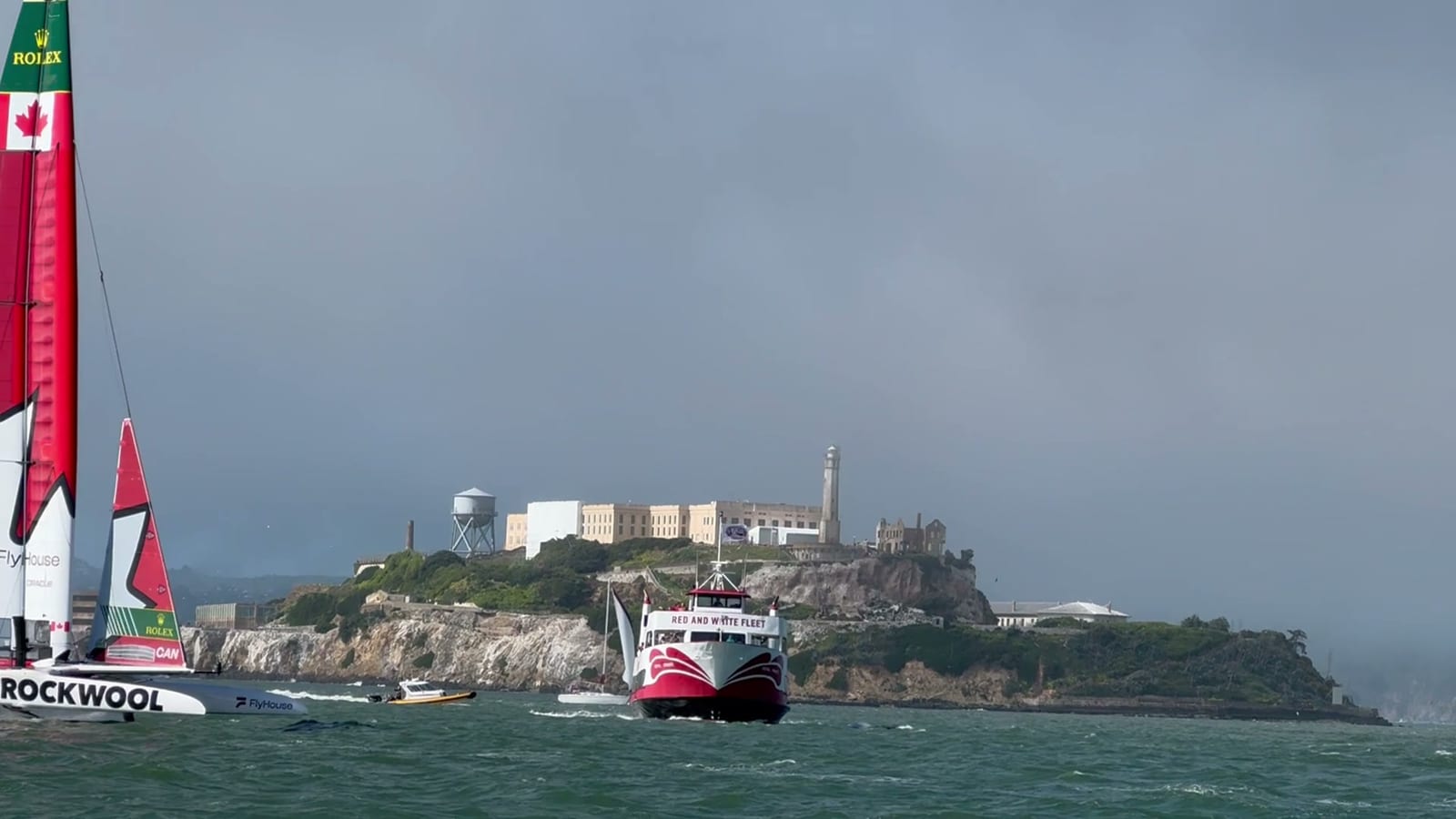
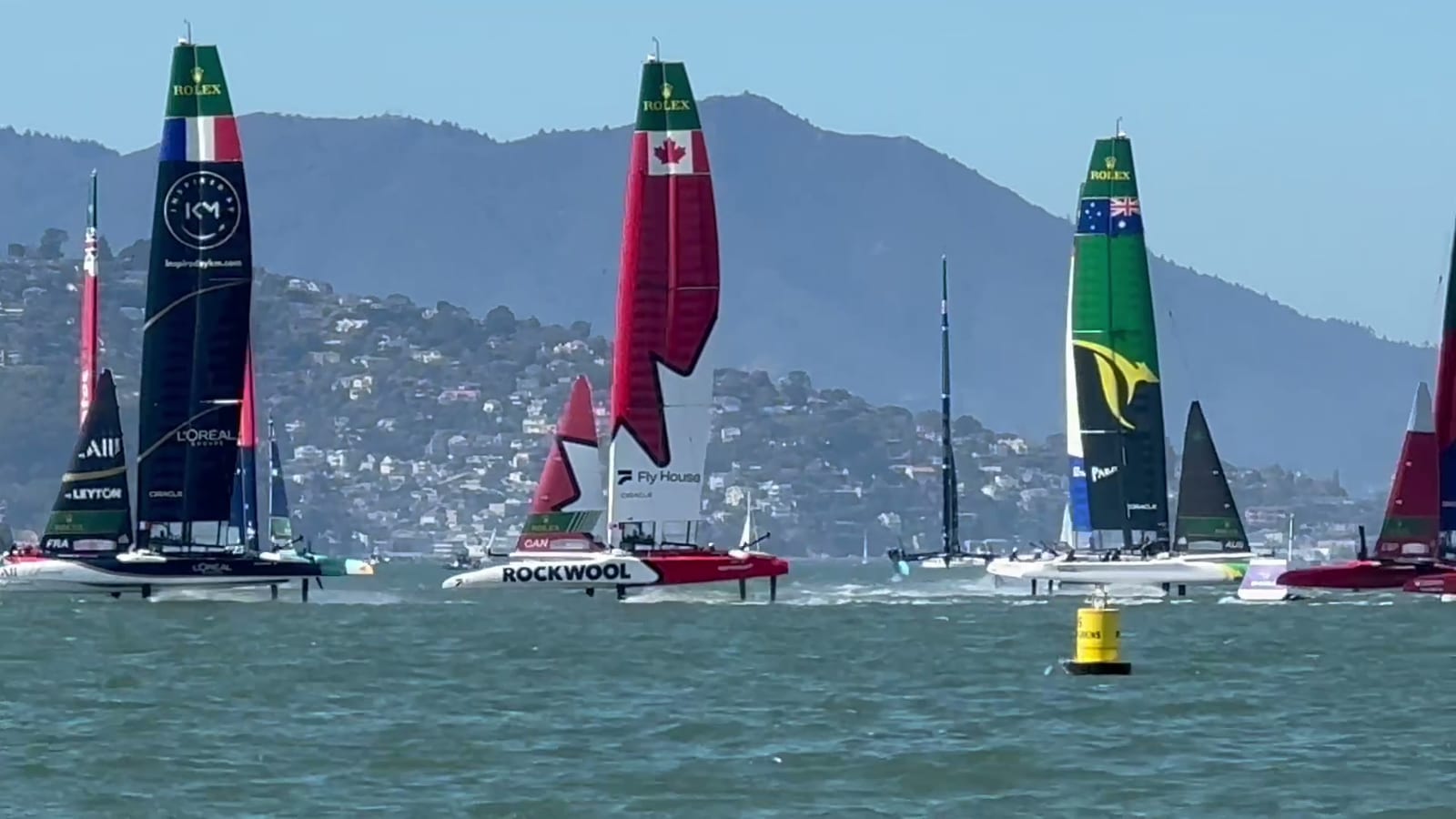
SailGP is coming back to San Francisco Bay on Saturday April 3 and Sunday April 4, 2027. If you have watched it before, you know the moment: a fifty-foot catamaran rises out of the water and flies across the Bay faster than the traffic on the shore.
It looks like a different sport from the one you learn on an Andrews 21. It is not. Almost everything an F50 does is an extreme version of something covered in your first sailing course. Here is how it works.
The boat, in numbers
- Length: about 50 feet (15 meters), a catamaran with two hulls
- Sail: a rigid wing plus a jib, with the wing built in sections so it can be made taller for light wind or shorter for heavy wind
- Crew: six
- Top speed: well over 50 knots, around 60 miles an hour
Every team races the same design. That is the point of the league: the boats are identical, so the result comes down to the sailors.
A wing is a mainsail that holds its shape
In Basic Keelboat 1 you learn that a sail works like an airplane wing. Air flowing around its curved shape creates lift, and lift pulls the boat forward. A cloth mainsail does this, but its shape changes with every gust, and the sheet, the traveler and the outhaul are all ways of controlling that shape.
An F50 takes the idea literally. Its mainsail is an actual wing, stiff and carefully shaped, so the crew can set the exact curve they want and it stays there. The trimmer is doing the same job you do with the mainsheet, just with far more precision and far more power.
Foils: why the hulls leave the water
Water is about eight hundred times denser than air, so pushing a hull through it takes a lot of energy. The faster you go, the more of that energy goes into making waves instead of speed. That is why a keelboat like the one you learn on has a practical top speed, however hard the wind blows.
An F50 gets around this by lifting out of the water completely. Under each hull is a hydrofoil, a small underwater wing. Once the boat is moving fast enough, the foils generate enough lift to raise both hulls clear. Only a foil and the rudders stay in the water, and with almost nothing left to drag, the boat accelerates hard.
Your keel and an F50's foils have something in common. Both stop the boat from simply sliding sideways, which is what lets any sailboat sail across the wind instead of only away from it. The F50's foils just do a second job at the same time: holding the boat up.
Apparent wind: making your own breeze
The wind you feel on a moving boat is not the wind blowing across the Bay. It is that wind combined with the breeze your own motion creates. Sailors call it the apparent wind, and you learn to read it with the telltales on the jib.
On an Andrews 21 the difference is small. On an F50 it is enormous. The boat can sail several times faster than the wind that is blowing, so the breeze it creates for itself is far stronger than the real one, and it comes from almost straight ahead. That is why the wing on an F50 is sheeted in tight nearly all the time, even when the boat is heading downwind.
Six people, one boat
On your boat, one person might steer, trim and keep a lookout all at once. On an F50 those jobs are split up and multiplied. A driver steers. A flight controller manages how high the boat flies above the water, which is the hardest new skill this kind of sailing adds. A wing trimmer handles the wing. Grinders turn the handles that power the wing's sheet, and a strategist keeps track of the course and the other boats.
The crew talks constantly, because at 50 knots a mistake turns into a crash in a fraction of a second. If you have ever been on a boat where the skipper calls a tack and the crew answers, you have done a slower version of the same thing.
Watch it, then go sailing
The SailGP course runs between Alcatraz and the Golden Gate Bridge, with grandstands on shore at the Marina. Race times for 2027 have not been announced yet; check SailGP's official site before you plan the day. To watch from a boat right on the edge of the course, our sister company runs private charters that weekend: here is how to watch SailGP from the water.
Then come and feel the same forces at a speed you can learn on. Lift, apparent wind and a keel that keeps you on course are all there on your first day. Basic Keelboat 1 is where it starts, and if you are wondering what that first day is like, here is what actually happens.
